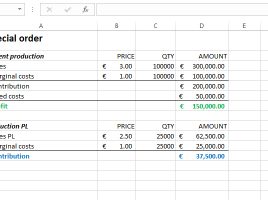
Marginal costs

Marginal costs in the economy are those generated by the production of an additional product unit, while in accounting they correspond to the average variable costs. By distinguishing between variable and fixed marginal costs, we can easily calculate whether to accept a special order or to discard the product. Let’s see it on the case of profitability of production under the private label.

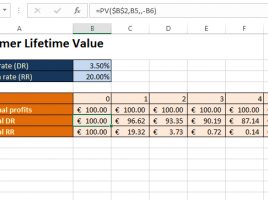
Customer lifetime value

The customer’s lifetime is the period in which we perform sales transactions, and the calculation of its value is a profit forecast based on the relationships that are mutually achievable. There are several ways to calculate it, and all of them show us profit flow that we can expect by retaining a customer. In other words, how much money comes if they pay regularly, if they are financed, and if a certain percentage of customers goes from year to year.

How much goods to order?

Most traders order intuitively, which is perfectly fine when dealing with small quantities of goods. When sales rises, in order to be efficiently ordered, insight in inventory costs is needed. These costs are divided into three groups: costs of acquisition, holding and lack of inventory (missed income due to lack of inventory). An economically justified order quantity is the one that causes the lowest inventory costs.

Refilling shelves

I often get upset when I go to the supermarket and see the workers closing the passages by racking up the shelves. How to help them? If a company has implemented an ERP, it is possible to extract a stock report, critical inventory, and a place where the items are located (warehouse, location, position). With a little imagination and knowledge of conditional formatting techniques, there is an easy way to mark those shelves and positions where urgent refill is required.

Should we keep the product?

In economics, the question often arises: Do you leave or keep a product? The answer to this dilemma is often difficult to find, but by analyzing the summary of the income statement we can come up with quantitative data that can make it easier for us to make such a decision. This is also an appropriate way to apply a Scenario method by which we can calculate alternatives depending on the steps taken.